What Is Content Operations? A Guide for Multi-Client Work
- Published
- November 21, 2026
- Reading
- 9 min read
- Share
In This Piece
- The Short Version
- What Is Content Operations?
- How Is Content Operations Different From Content Strategy?
- What Does Content Operations Look Like in an Agency?
- What Are the Parts of Content Operations for an Agency?
- What Does a Content Operations Manager Do?
- Where Does Agency Content Ops Break?
- Do You Need a Content Operations Platform?
- Where GoMimic Fits
- Questions People Ask
Content operations, or content ops, is the system of people, steps, and tools that gets content from an idea to a finished, approved, delivered piece, again and again. For an agency it's the same job multiplied by every client, so the system also has to keep each client's voice, facts, approvers, and deliverables apart while they all run through one team.
The Short Version
- Want the plain definition? Start here: strategy decides what to say, operations decides how it gets made, approved, and delivered.
- Running more than a handful of clients? Split your ops into two layers: one shared system, and a file per client.
- Hiring for it? Here's what a content operations manager does in an agency.
- Wondering where it usually breaks? Approval, not writing. That's where the rounds and the waiting pile up.
- Want the client layer, the approvals, and the record kept in one place? That's what GoMimic is for.

What Is Content Operations?
Content operations is the behind-the-scenes work that makes content happen on time and at the quality you promised. Content Science defines it as "the behind-the-scenes work of managing content activities as effectively and efficiently as possible" (Content Science Review). It sorts that work into people, process, and technology.
In plain terms, content ops answers the questions nobody asks until something goes wrong:
- Who writes this, who edits it, and who signs it off?
- Where does the brief live, and where does the approved version live?
- What happens when the client asks for changes on a Friday?
- How does the next writer know how this client sounds?
If those answers live in one person's head, you have content. You don't have content operations yet.
How Is Content Operations Different From Content Strategy?
Strategy decides what to say, to whom, and why. Operations decides how it gets made, checked, approved, and delivered, every week, without heroics.
A good strategy with weak ops looks like this: the plan is clear, and the March newsletter still goes out late because nobody knew the client's CFO had to see it. Strong ops with no strategy looks like the opposite: a smooth machine turning out posts nobody needed.
In our view, ops should serve the thinking, never replace it. At GoMimic we think good content operations make the process faster without cutting the thinking your clients pay for. Efficient processes beat speed for its own sake. A system that only optimizes volume will happily produce more posts that say nothing.
Most agencies haven't made that choice yet. In Spark AI's autumn 2026 report on AI in agencies, 91% of staff who use AI say it saves them time. Asked where the time goes, 48% said more output in the same time and 41% said better-quality work, and only 9% of agencies had redesigned a workflow from start to finish (Spark AI, The Spark Report, Autumn/Winter 2026/27). Spark sells AI courses to agencies, so read it as one firm's survey. That's speed bolted onto the old process. Content operations is the redesign: deciding where the saved time goes. In our view it belongs to the client's thinking and the client's approval, not to more posts.
What Does Content Operations Look Like in an Agency?
Most content ops guides are written for one company with one brand. An agency has a harder version: the same team, the same week, and five or twenty brands that must never bleed into each other.
So split it into two layers.
The shared layer is the same for every client:
- How work comes in: a brief, a call, a draft, or a published post.
- Who writes, who edits, and who signs off inside the agency.
- How a client review runs: how it's sent, how answers come back, and what happens to a "no".
- How approved work is handed off, and where the record lives.
The client layer is one file per client:
- How they sound, the words they avoid, and what they've corrected before.
- Their facts: products, names, and the claims they can and can't make.
- Who signs off on their side, and who only gets a copy.
- What they get each month, and when.
The shared layer keeps the team fast. The client layer keeps every client sounding like themselves. Lose the second one and you get the agency's worst moment: one client's words in another client's draft.
What Are the Parts of Content Operations for an Agency?
Five parts, in the order a piece moves through them. Our guide to the content creation process breaks them into stages and owners. Here's the short version.

- Intake. Every piece starts from something real: the client's own post, a call, their notes, or their take on a topic. Not from a keyword alone.
- The client's voice and facts. Read before anyone writes, not after.
- Creating. The draft, then an internal edit for the point, the reader, and the voice.
- Approval. The team signs off, then the client does, post by post, with every answer recorded.
- Delivery and the record. The approved version, and only that version, goes out, and you can show who said yes and when.
Notice what comes first. Content ops for an agency starts with the client's own thinking. Everything after it should carry that thought further, not water it down.
What Does a Content Operations Manager Do?
A content operations manager owns the system rather than the words. In an agency, that usually means:
- Keeping each client's file current, so a new writer can start without a handover call.
- Running the approval calendar: what's with which client, what's late, and who needs a nudge.
- Fixing the same problem once. When a client corrects the same phrase twice, it becomes a rule, not a third edit.
- Choosing and wiring the tools, and retiring the ones nobody uses.
- Reporting on the system: where work waits, how many rounds a piece takes, and what slipped.
The skills are part editor, part project manager. You need taste to know a draft isn't the client yet, and patience to chase a sign-off without souring the relationship. In our experience, until the roster grows, it's often the founder's job, done unofficially.
Where Does Agency Content Ops Break?
At approval, more than anywhere else. In an IPA study of creative development published in March 2025, only 23% of agencies agreed the current approval process works well, against 56% of marketers. It typically took 5 rounds to reach a signed-off idea, up from 3 in IPA research from 2007 (IPA, BetterIdeas Project, March 4, 2025).
Voice is the other weak spot, now that AI writes many first drafts. In the Content Marketing Institute and MarketingProfs survey of 861 B2B marketers, 52% named maintaining brand voice and authenticity among their biggest challenges in using AI to create content (CMI, 2027 B2B trends research).
Both failures come from the same gap. The client's yes and the client's voice live in inboxes and people's heads, not in the system. Write them into the system and most of the chasing goes away. We cover the client's side of that in how to get client sign-off without chasing.
Do You Need a Content Operations Platform?
Not to start. A shared folder per client, one approval sheet, and a named owner will take you further than you'd expect.
The well-known content operations platforms, like Contentful and Acquia, describe content ops as the people, processes, and technology an organization uses to create, store, manage, and distribute its content. Acquia calls it the execution side of a content strategy. That's a good fit for one brand with a big web estate.
An agency needs something different. The unit isn't the content type. It's the client. When you choose software, ask four questions:
- Does each client get their own voice, facts, and rules, kept apart?
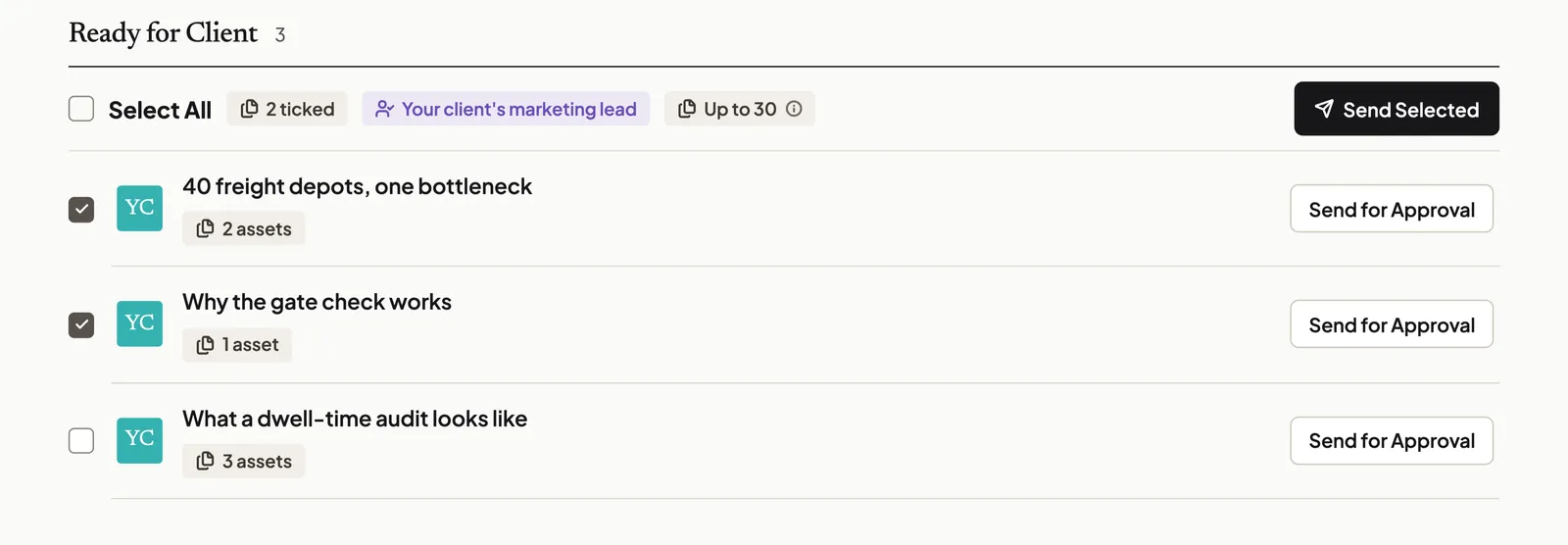
- Can the client approve without an account, post by post, with a record?
- Does approved text stay locked, so what goes out is what they said yes to?
- Can you see what's waiting on whom across every client at once?
Faster, Not Thinner
Good content operations make the process faster without cutting the thinking your clients pay for.
Where GoMimic Fits
Create client content in each client's voice. Get it approved. Deliver it. GoMimic is the Connected Content System for Client Work, built for content worth putting your client's name on. We make it, so weigh what we say about it accordingly.
It's content operations built around the client, not the document:
- The client layer, kept for you. You add a client once. Their voice, rules, facts, and approved work sit with the client. Each client's voice gets better with every piece you create and every approval, so there's less to fix each time.
- Their thinking first. A blog post, article, or newsletter starts from Your Original Take: what your client thinks and what the piece is for.
- Approval with a record. The client reviews by link, with no login, and answers post by post. Every decision is recorded, and approved text locks.
- One view across clients. The Approvals page shows what's ready, what's with the client, and what came back.
- Delivery of exactly what was approved. Copy it, save it to Google Drive or Notion, send it to Slack, send it as a draft to Buffer, Kit, or Mailchimp, or pass it on by webhook to Zapier. GoMimic never posts.
Where it falls short: it doesn't plan your content strategy, and it won't write from a keyword alone. It never posts, by design: the approved version goes to the scheduler you already use, unchanged. And a new client with no writing of their own starts with only what you write down.
Questions People Ask
What is content operations in simple terms?+
The system of people, steps, and tools that gets content from an idea to a finished, approved, delivered piece, reliably. Strategy decides what to say; content operations decides how it gets made and out the door.
What is the role of content operations?+
To make content happen on time and at the promised quality, without depending on one person's memory. In an agency, that includes keeping each client's voice and facts current, running approvals, and keeping a record of what was approved.
What does a content operations manager do?+
They own the system rather than the words: client files, the approval calendar, the tools, and reports on where work waits. In our experience, the founder often does this job unofficially until the roster grows.
What's the difference between content ops and content strategy?+
Strategy is what to say, to whom, and why. Content ops is how it gets created, reviewed, approved, and delivered every week. You need both; good ops can't save a weak strategy, and a good strategy stalls without ops.
What is a content operations platform?+
Software that helps run content work: storing, creating, reviewing, and delivering it. Many are built for one organization's own content. An agency should look for one that treats each client as its own unit, with client approval and a record built in.
What is an example of content operations?+
A client's monthly newsletter: the call it starts from, the draft written from the client's notes and voice, the internal edit, the client's approval on one link, and the approved version handed to their email tool, with a record of who said yes.
Written by the GoMimic team
GoMimic helps you create client content, get it approved, and deliver it, in each client’s voice.
Why It WorksMore from GoMimic
Client Onboarding Questionnaire for Content Work, With a Free Template
A client onboarding questionnaire for content work: 20 questions to copy, what to ask for besides answers, who approves, and what to do with the replies.
Content Creation Workflow for Client Work, Step by Step
A content creation workflow for client work: eight stages from request to report, who owns each one, the client file they share, and a worked example.