AI Words to Avoid, and What to Write Instead
- Published
- November 20, 2026
- Reading
- 13 min read
- Share
In This Piece
- The Short Version
- Where Did the AI Words Come From?
- The List: AI Words and What to Write Instead
- Which Phrases Give AI Writing Away?
- Why Does the List of AI Words Keep Changing?
- Start From a Human Thought, Not a Word List
- How Do You Avoid Sounding Like AI?
- Should You Ban the Same Words for Every Client?
- Where GoMimic Fits
- Questions People Ask
The AI words to avoid are the ones readers have learned to spot: delve, tapestry, underscore, showcase, pivotal, crucial, landscape, testament, foster, and vibrant, plus stock phrases like "in today's fast-paced world". Swap each for the plain word a person would use, which is usually shorter, and the draft stops waving a flag.
The Short Version
- Our view first: better instructions and a banned list help, but they're guardrails. The real fix is starting from a person's idea and the client's own material, so the AI follows a thought instead of running free.
- Just want the list of overused AI words? Jump to the swaps: every word, and what a person would write instead.
- Wondering why yesterday's list stopped working? Delve faded in 2025 and the new giveaways are ordinary words. Here's how the list moves.
- Want to stop sounding like AI, not just swap words? Start from the point and the client's own words, then run the list.
- Writing for many clients? Keep a house list and a list per client, and never cut a word that's really theirs.
- Want both lists checked on every piece, without anyone remembering to? That's what GoMimic does.
The word lists below come from a published study, Wikipedia's editors, and the UK government's style guide, linked as we go and checked on November 20, 2026.

Where Did the AI Words Come From?
Researchers can see them in the numbers. A study in Science Advances read more than 15 million biomedical abstracts from 2010 to 2024 and looked for words that suddenly turned up far more often than expected. In 2024, "delves" appeared about 28 times as often as the authors expected, "underscores" about 14 times, and "showcasing" about 11 times. More common words like "potential", "findings", and "crucial" rose too (Kobak and others, Science Advances, July 2025).
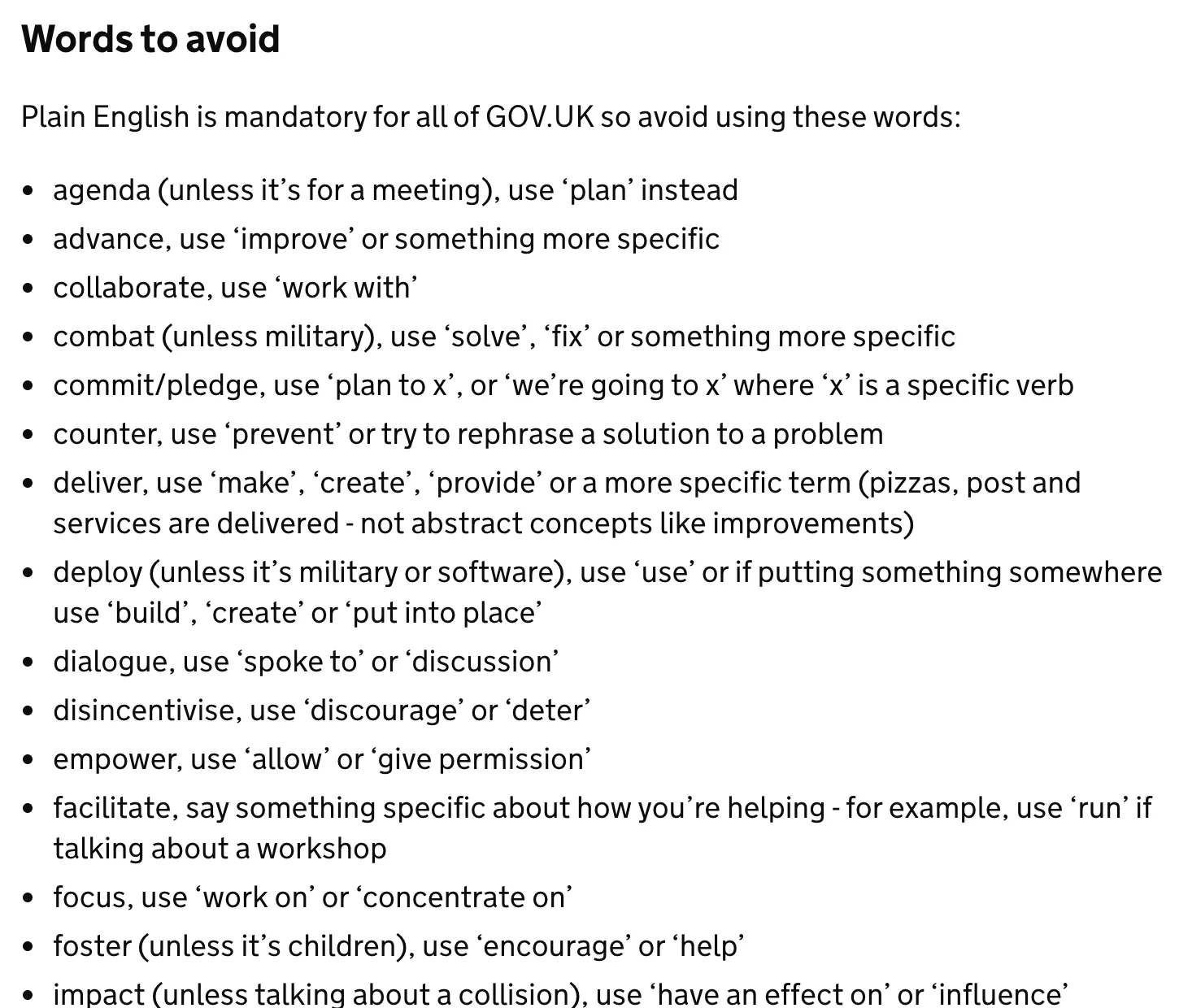
Most of these were never new words. Plenty were office words long before any chatbot. The UK government's style guide tells its writers to avoid "leverage", "foster", "robust", "streamline", "facilitate", "key", and "empower", and it gives the plain word for each (GOV.UK A to Z style guide). Chatbots learned from human writing, and they leaned hard on the words that already made writing sound important without saying much.
Marketers feel it too. In the Content Marketing Institute and MarketingProfs survey of 861 B2B marketers, 75% said they're concerned AI is making audiences more skeptical of online content (CMI, 2027 B2B trends research).
At GoMimic we think AI was supposed to help us say what we mean, and the way it's been used has taught readers to distrust it. Swapping words won't win that trust back on its own. It's a start, and it's the easiest part.
The List: AI Words and What to Write Instead
Here's the list, grouped by the job each word does in a sentence. The words come from the Science Advances study, Wikipedia's field guide to AI writing, and the GOV.UK words to avoid. A few, like "seamless", "realm", and "let's dive in", are ones we cut from drafts ourselves. The swaps are ours. Often the best swap is to cut the word and say the specific thing.
Verbs
| Word | Write instead |
|---|---|
| delve, delve into | look at, get into, or just start |
| underscore | show, stress |
| showcase | show |
| highlight (as a verb) | show, point out |
| foster | encourage, help |
| leverage | use |
| enhance | improve, or say how |
| streamline | simplify, cut steps |
| align with | fit, match, agree with |
| garner | get, win |
| bolster | support, strengthen |
| navigate | handle, deal with |
| elevate, unlock | say what actually gets better |
Adjectives
| Word | Write instead |
|---|---|
| pivotal, crucial | important, or cut it |
| robust | strong, well thought out |
| seamless | smooth, or say what doesn't break |
| vibrant | lively, or a fact that shows it |
| intricate | detailed, complicated |
| meticulous | careful |
| enduring | lasting |
| comprehensive | full, complete |
| multifaceted | say which sides |
Nouns and metaphors
| Word | Write instead |
|---|---|
| tapestry | mix |
| landscape | market, field, or name it |
| testament to | shows, proves |
| realm | area |
| interplay | how A and B affect each other |
| game-changer | say what changed |
| deep dive | a close look |
Openers and connectors
| Phrase | Write instead |
|---|---|
| In today's fast-paced world | start with the point |
| Additionally, Furthermore, Moreover | also, and, or a new sentence |
| It's worth noting that | cut it and say the thing |
| When it comes to | for, about |
| Let's dive in | cut it |
Endings
| Phrase | Write instead |
|---|---|
| In conclusion, Ultimately | cut it |
| A recap of the whole piece | one line on what to do next |
| As we navigate the future of | stop one sentence earlier |
Use it with two caveats. A word on this list isn't wrong. "Crucial" is a fine word when something really is crucial, and a client who writes "robust" about a bridge is right. And one or two of these in a draft mean very little. Wikipedia's editors make the same point: a few may be coincidence, and it's lots of them, lots of times, that gives a draft away.
Which Phrases Give AI Writing Away?
Words are the easy part. The shapes around them give more away, because a writer can swap "delve" for "look at" and keep the shape. These are the ones we'd look for first, and Wikipedia's field guide lists most of them:
- A correction nobody asked for. "It's not just a tool, it's a partner." Nobody said it was just a tool.
- Threes out of habit. "Faster, smarter, and more human", when there was one thing to say.
- Inflated stakes. "Plays a pivotal role in shaping", where "helps" would do.
- Vague credit. "Experts agree" or "studies show", with no expert and no study.
- A frame around nothing. An opening that restates the title, and an ending that sums up what you just read.
- The same rhythm everywhere. Every paragraph the same length, every sentence the same shape.
Our editing checklist has the full pass for these, and where it sits in an edit.

Why Does the List of AI Words Keep Changing?
Because the tools change, and the people who build them read the same lists you do. Wikipedia's volunteer editors keep a field guide to AI writing that sorts the giveaway words by when they were common. By their account, delve was overused in 2023 and early 2024, became less frequent later in 2024, and dropped off sharply in 2025. Their list for mid-2026 on is full of ordinary words: "practical", "steady", "quietly", "clearer", and "matters", with shorter sentences.
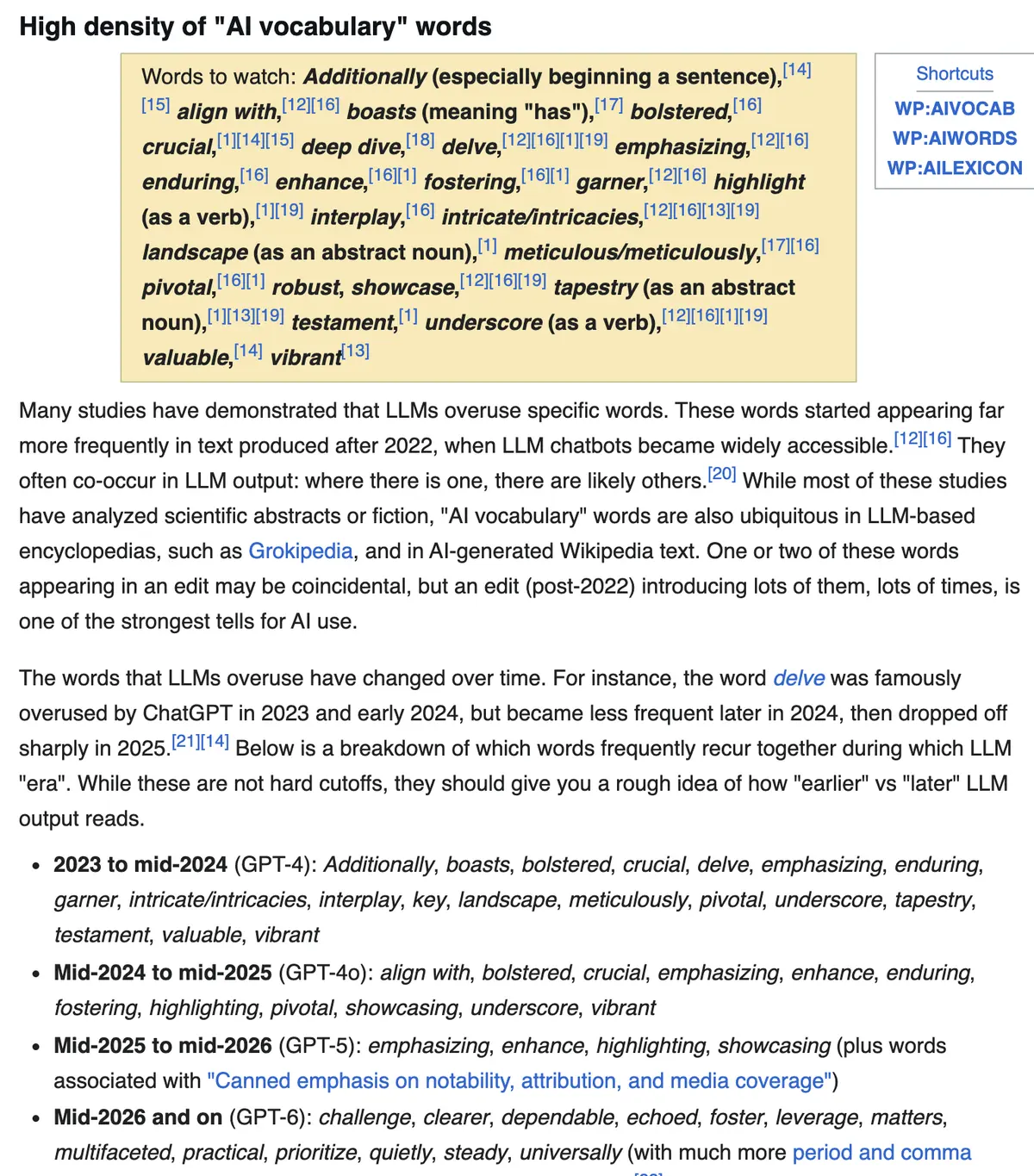
Long dashes went the same way. The guide now files heavy use of the long dash as a sign that held from 2022 to September 2026. Newer chatbots are more and more often set to avoid it, and the editors say the result is drafts with so many commas and periods that the plain punctuation has become a sign in its own right.
So a ban list is always a little behind. Ban "delve" today and you're fixing last year's draft. Ban "practical" and you've banned a word your clients use every week. The words a reader notices are a symptom. What they're really reacting to is a draft that sounds like nobody in particular.
Start From a Human Thought, Not a Word List
Here's our point of view, and it runs through everything we build: a human thought leads, and AI follows it.
Better instructions help. A banned list helps too, and we keep one. Both are guardrails. They tell the draft what not to do. They don't tell it what to say.
Give AI a topic and not much else, and it fills the gaps. It reaches for the safe word, the tidy three, the summary ending, because there's nothing of yours to reach for. Ban "delve" and it finds the next safe word. When you let it roam free, it roams free.
So steer it before it starts. Give it the person's real idea, the one sentence they'd defend in a meeting. Give it the client's own material: their posts, their call notes, their numbers, the things they've corrected you on. Give it their take on the topic, not just the topic. Then there's far less room for filler, because the draft has something real to carry.
The word list still runs. It just runs last, on a draft that already has a point.
How Do You Avoid Sounding Like AI?
Give the draft a person to sound like, and a point to make. The word list comes after that.
- Start from the point. If you can't say what the piece argues in one sentence, no swap will help. Write that sentence first.
- Use the client's own words. Read two or three things they wrote or approved before you edit. Their phrases, their examples, and their opinions do more than any list of what to avoid.
- Keep the details only they have. A number from their business, a customer question they hear every week, or a view they'll stand behind. Generic drafts are generic because the specifics never went in.
- Vary the rhythm. A short sentence after a long one. A paragraph of one line when the point deserves it.
- Then run the list. Swap what the client wouldn't say, and leave what they would.
That order is the whole idea of our editing checklist: the point first, the reader second, the client's voice third, and the AI tells fourth. Take out every tell from a draft that fails the first three and you get a cleaner draft with nothing in it. In our view the goal isn't to fool a detector. It's a draft the client would have written on a good day.
Should You Ban the Same Words for Every Client?
Keep two lists, not one.
- A house list, across every client. The words nobody on your roster would ever use: tapestry, delve, "in today's fast-paced world". Short, shared by the whole team, and checked on every draft.
- A list per client. The words this client avoids, plus the ones they've corrected you on. A law firm that never says "solutions". A bakery that hates "artisanal". These matter more than anything above, because the client wrote them.
And one more column on each client's list: the words that look like tells but are theirs. A founder who says "crucial" in every talk should hear "crucial" in her posts. Cutting a client's real habits to dodge a list makes the draft sound less like them, which is the opposite of the point. If you haven't written a client's voice down yet, our brand voice and tone of voice examples show how.

Swaps Don't Make a Point
Swap every word on the list and a draft can still say nothing. The words were never the real tell.
Where GoMimic Fits
Create client content in each client's voice. Get it approved. Deliver it. GoMimic is the Connected Content System for Client Work, built for content worth putting your client's name on. We make it, so weigh what we say about it accordingly.
GoMimic is built around that stance: the person's thought goes in first, and the guardrails run after.
- The take comes first. A blog post, article, or newsletter starts from Your Original Take: what your client thinks and what the piece is for. It won't write an article from a keyword alone.
- The client's own material and rules. Every piece is written with the facts and rules you keep for that client, from their own writing and calls.
- A person approves before anything goes out. Your team signs off, then the client approves on one link, with no login. GoMimic never posts.
The two lists above are kept for you too, and checked on every piece, so nobody has to remember.
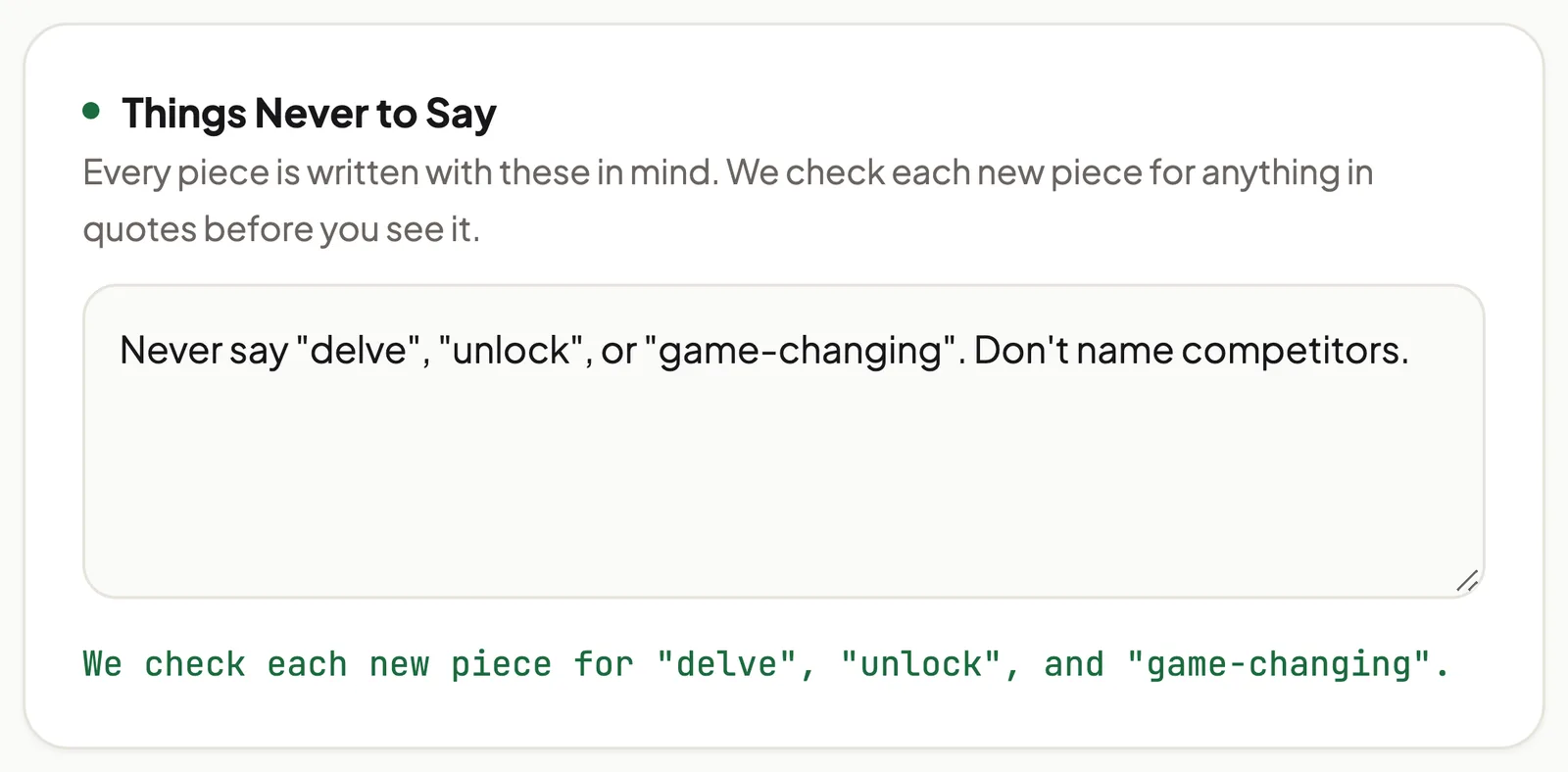
- One client's list. Things Never to Say holds that client's phrases. Put a phrase in quotes and every new piece is checked for it, and only the sentence holding it is rewritten.
- Your house list. Stock Phrases is your own list across every client, with delve, tapestry, and the rest on it from the start. Any Stock Phrases left in are fixed before your editor opens the piece.
- Corrections that stick. When a client's comment keeps coming back, Keep This for Next Time turns it into a rule for that client.
- A voice that gets closer. Each client's voice gets better with every piece you create and every approval, so there's less to fix each time, including the words they'd never use.
Where it falls short: it can't tell you whether a draft has a point. That call, and the last read of the client's voice, stay with a person who knows the client. Our anti-slop manifesto says why we built it that way.
Questions People Ask
Is "delve" an AI word?+
It became one. A Science Advances study found "delves" in 2024 biomedical abstracts at about 28 times the expected rate. Wikipedia's field guide says its use dropped off sharply in 2025, so newer drafts give themselves away with other words.
What words get flagged for AI?+
Usually the words in the list above, especially in clusters: delve, underscore, showcase, pivotal, crucial, tapestry, and testament, plus phrases like "it's not just X, it's Y". One of them alone rarely gives a draft away. Several in one paragraph do.
What should I write instead of AI words?+
The plain word a person would say: "look at" for delve, "show" for showcase, "use" for leverage, and "important" for pivotal. Often the better swap is to cut the word and state the specific thing it was standing in for.
How do you avoid sounding like AI?+
Start from a point you can say in one sentence, use the client's own words and details, and vary your rhythm. Run the word list last. A draft with every AI word removed can still sound like nobody wrote it.
How do you not sound like ChatGPT?+
Give it your point and your material before it writes, then edit for the client's own words and rhythm. Run the word list last. Most of what sounds like ChatGPT is a draft with no point and no specifics, not a single word.
Why do I sound like an AI?+
Often because the writing is generic rather than because of any one word: no specific detail, no opinion, every sentence the same length, and an ending that sums up what came before. Add what only you know, and vary the rhythm.
Should you stop using long dashes?+
Not because of AI. Wikipedia's field guide now treats heavy long-dash use as a sign that held until September 2026, since newer chatbots are often set to avoid them. If a client uses long dashes, keep them.
Do AI detectors look for these words?+
We can't say how any detector decides; that's up to each maker. What we can say is that readers notice them, and a reader is the one you're writing for.
Written by the GoMimic team
GoMimic helps you create client content, get it approved, and deliver it, in each client’s voice.
Why It WorksMore from GoMimic
Editing Checklist for Agency Content (With the AI-Tell Pass)
An editing checklist in the order an editor reads: the point, the reader, the client's voice, an AI-tell pass, and the facts. Copy it for any draft.
Why Each Writer Rebuilding Client Instructions Breaks Down
Client instructions for AI writing break down when each writer keeps a copy. Why it happens, what chat tools fix, and where the instructions should live.