Brand Voice and Tone of Voice Examples, and How to Write Each Client's
- Published
- November 20, 2026
- Reading
- 13 min read
- Share
In This Piece
- The Short Version
- What's the Difference Between Brand Voice and Tone of Voice?
- Brand Voice Examples From Brands That Publish Theirs
- Tone of Voice Examples: One Message, Four Tones
- What Turns a Tone Into Rules a Writer Can Follow?
- How Do You Find and Write a Client's Brand Voice?
- Why Is a Brand Voice the Floor, Not the Point?
- How Do You Keep Many Clients' Voices Apart?
- Where GoMimic Fits
- Questions People Ask
A brand voice is the personality a client's writing keeps everywhere, and tone is how that voice shifts for the moment. Mailchimp, for example, describes its voice as plainspoken, genuine, and dry, and says its tone changes with the reader's state of mind, while Atlassian's voice is "bold", "optimistic", and "practical, with a wink".
The Short Version
- Our view first: voice is the floor, not the point. A human thought leads, and the voice carries it. A draft can sound exactly like the client and still say nothing.
- Want real brand voice examples? Read five brands that publish their own voice: Mailchimp, Atlassian, Microsoft, Monzo, and GOV.UK, in their own words.
- Want tone of voice examples? See one message written four ways, on Nielsen Norman Group's four dimensions.
- Writing a client's voice from scratch? Start from their own writing, not from adjectives, and test it with a rival's name.
- Want writers to actually follow it? Turn the tone into three lists: what they say, never say, and know to be true.
- Want each client's voice kept, checked, and getting better with every approval? That's what GoMimic is for.
The brand examples come from each brand's own guide, linked and checked on November 20, 2026. The client examples are made up, and we say so where they appear.

What's the Difference Between Brand Voice and Tone of Voice?
Voice is the client's personality in writing, and it barely changes. Tone is how that personality adjusts to the moment, and it changes all the time. Mailchimp's style guide puts it in one line: "Our voice doesn't change much from day to day, but our tone changes all the time" (Mailchimp).
Think of a client you know well. They sound like themselves in a launch post and in an apology. But they don't sound the same in both. The launch can be excited. The apology can't. Voice is what stays, and tone is what they adjust for the reader.
For an agency, the difference decides what you write down. The voice goes in the client's notes once and stays there. Tone is a call each writer makes per piece, and it's the call most often missed, so it helps to write down how the client's tone shifts for the situations you write for most.
Brand Voice Examples From Brands That Publish Theirs
Most lists of brand voice examples describe famous brands from the outside. We'd rather use the ones brands wrote for their own writers. Five worth reading in full:
Mailchimp: plainspoken, genuine, and dry. Mailchimp's Content Style Guide says it writes like an experienced business partner who has been in the customer's shoes. Its voice is plainspoken, genuine, a translator of jargon, and dry in its humor, and it puts being clear above being entertaining. What to copy: it says what it isn't in the same breath as what it is.

Atlassian: bold, optimistic, and practical, with a wink. Atlassian's design system names three traits, then says when to turn each one down. Be less bold when someone feels confused or anxious, as a new user often does. What to copy: every trait comes with the moments it should get quieter.
Microsoft: warm and relaxed, crisp and clear, ready to lend a hand. The Microsoft Style Guide says its voice stays constant while its tone moves from serious to empathetic to lighthearted to fit the reader's state of mind. What to copy: plain style tips under each trait, like getting to the point fast and talking like a person.
Monzo: straightforward kindness, everyday magic, warm wit. Monzo's writing principles say where each trait belongs: kindness in everything, magic mainly in marketing, and wit almost only in marketing, with the odd surprise in the app. What to copy: a voice can be on everywhere and turned up in only some places.
GOV.UK: plain English, no exceptions. The UK government's style guide makes plain English mandatory, then backs it with a list of words to avoid and what to write instead: "work with" for "collaborate", "use" for "leverage". What to copy: a voice can be mostly rules about words, and that's often what a writer needs most.

Each one gives a writer choices to act on, which is more than a row of nice brand voice adjectives ever does. Hold anything you write for a client to the same test.
Tone of Voice Examples: One Message, Four Tones
Nielsen Norman Group found that tone comes down to four dimensions, each a spectrum: formal or casual, serious or funny, respectful or irreverent, and matter-of-fact or enthusiastic (NN/g). Every client sits somewhere on all four, and so does every piece they publish.
Here's one made-up message from a made-up accounting firm: the tax filing deadline is two weeks away, so send documents by April 1. The facts stay fixed. The tone moves.
- Formal and matter-of-fact: "The filing deadline is April 15. Please send your documents by April 1 so we can prepare your return."
- Casual: "Tax day is two weeks out. Send us your documents by April 1 and we'll take it from there."
- Enthusiastic: "Two weeks to go! Send your documents by April 1, and you can forget about tax day."
- Funny and a little irreverent: "April 15 is coming whether we like it or not. Beat it by sending your documents by April 1."
None is wrong. Which is right depends on the client and the reader. A firm whose clients are anxious small-business owners might choose casual. A firm that advises hospital boards would choose formal, and would never send the funny one. That's why a tone example only helps when it comes with a rule.
What Turns a Tone Into Rules a Writer Can Follow?
For each client, write the tone down as three short lists, the way you'd brief a new writer:
- What they say: the words, openings, and phrases they reach for. "Tax day", not "the filing deadline". "We'll take it from there."
- What they never say: words and moves they'd reject. No exclamation marks. Never "cheap". Never a joke about money worries.
- What they know to be true: the facts behind the voice. They file for small businesses in one state. They answer the phone themselves. Their deadline advice is always "two weeks early".
Most voice guides skip the third list, and it's the one that makes a voice sound like one firm and not every firm. Two accounting firms can share a casual tone. Only one of them answers its own phone.

How Do You Find and Write a Client's Brand Voice?
Start from what the client has already written, not from what they say they want to sound like. In our experience, ask a client how they sound and you get a pair of adjectives, like "friendly but professional", that any competitor could claim too.
- Collect five to ten pieces the client wrote themselves, or approved without many changes. Mix formats: a post, an email, a page, a talk transcript if they have one.
- Mark their habits. How long are their sentences? How do they open? Do they use contractions, "we", "you"? Which words come up again and again? What do they never do?
- Place them on the four dials. Formal or casual, serious or funny, respectful or irreverent, matter-of-fact or enthusiastic. Agree it with the client in one short call.
- Write the voice in two or three sentences, with a "but not" for each trait. "Warm, but never cutesy. Direct, but never blunt about money."
- Add the three lists above, and a short note on how the tone shifts: launches, bad news, LinkedIn, the newsletter.
- Test it. Write one piece from the notes alone, then swap in a competitor's name. If it still works, go back to step 2.
- Keep it current. When the client corrects a phrase, add it the same day. A voice written once and never touched goes out of date faster than anyone notices.
Keep the result short. A voice note a writer reads in two minutes gets used. A long brand book tends to get skimmed once.
Why Is a Brand Voice the Floor, Not the Point?
At GoMimic we think a brand voice is the bare minimum, not the end. The value comes from the thought the client is trying to get across, and no voice guide can make that up for you.
You've probably read a draft that sounds exactly like the client and says nothing. Right words, right rhythm, right sign-off. The voice did its job, and the piece still went back, because there was no idea in it that the client would put their name on. A voice makes a client's thinking sound like them. It can't supply the thinking.
It's the same with AI. A voice guide and a list of banned words are guardrails, and they help. But give AI a voice and no idea, and it fills the gaps with something that sounds right. In our view, the fix is to start from the client's real thought and their own material, so the AI follows a point instead of running free.
So brief the idea first, then the voice. Our editing checklist puts the point first and the voice third for the same reason. And if the AI words are what's making a client sound like everyone else, we keep a list of AI words to avoid, with what to write instead.
How Do You Keep Many Clients' Voices Apart?
It gets harder with every client you add, and not only with AI. In the Content Marketing Institute and MarketingProfs survey of 861 B2B marketers, 52% named maintaining brand voice and authenticity among their biggest challenges in using AI to create content (CMI, 2027 B2B trends research).
Three habits help across a roster:
- One home per client voice. Not a copy in each writer's chat tool. When four writers each keep their own version, you get four voices. We walk through that in why each writer rebuilding client instructions breaks down.
- A second voice when the client has one. The company page and the founder rarely sound the same. Write them down separately, sharing only the facts.
- Read with the names covered. Put two clients' drafts side by side without their names. If you can't tell whose is whose, one of them has lost its voice.
Our Learn page on keeping client voices apart goes further, step by step.
Voice Is the Floor
A brand voice is the bare minimum, not the end. The value comes from the thought the client is trying to get across.
Where GoMimic Fits
Create client content in each client's voice. Get it approved. Deliver it. GoMimic is the Connected Content System for Client Work, built for content worth putting your client's name on. We make it, so weigh what we say about it accordingly.
Everything this post asks you to write down, GoMimic keeps on each client's Voice page, and it uses it on every piece.
- The thought before the voice. A blog post, article, or newsletter starts from Your Original Take: what your client thinks and what the piece is for. The voice carries it.
- Their voice, in your words. Their Rules hold How This Client Sounds in up to 600 characters, plain choices like sentence length and contractions, and lists to Use, Avoid, and Never Sounds Like. You add pieces that sound like them and pieces that don't.
- Habits from their own writing. Add the client's writing and GoMimic learns their habits, each one shown with the posts it came from. Habits from approved work are used only once your team keeps them.
- A voice that gets better. Each client's voice gets better with every piece you create and every approval, so there's less to fix each time.
- More than one voice per client. The founder and the company page can each have their own voice: 3 per client on Pro, and 8 on Agency.
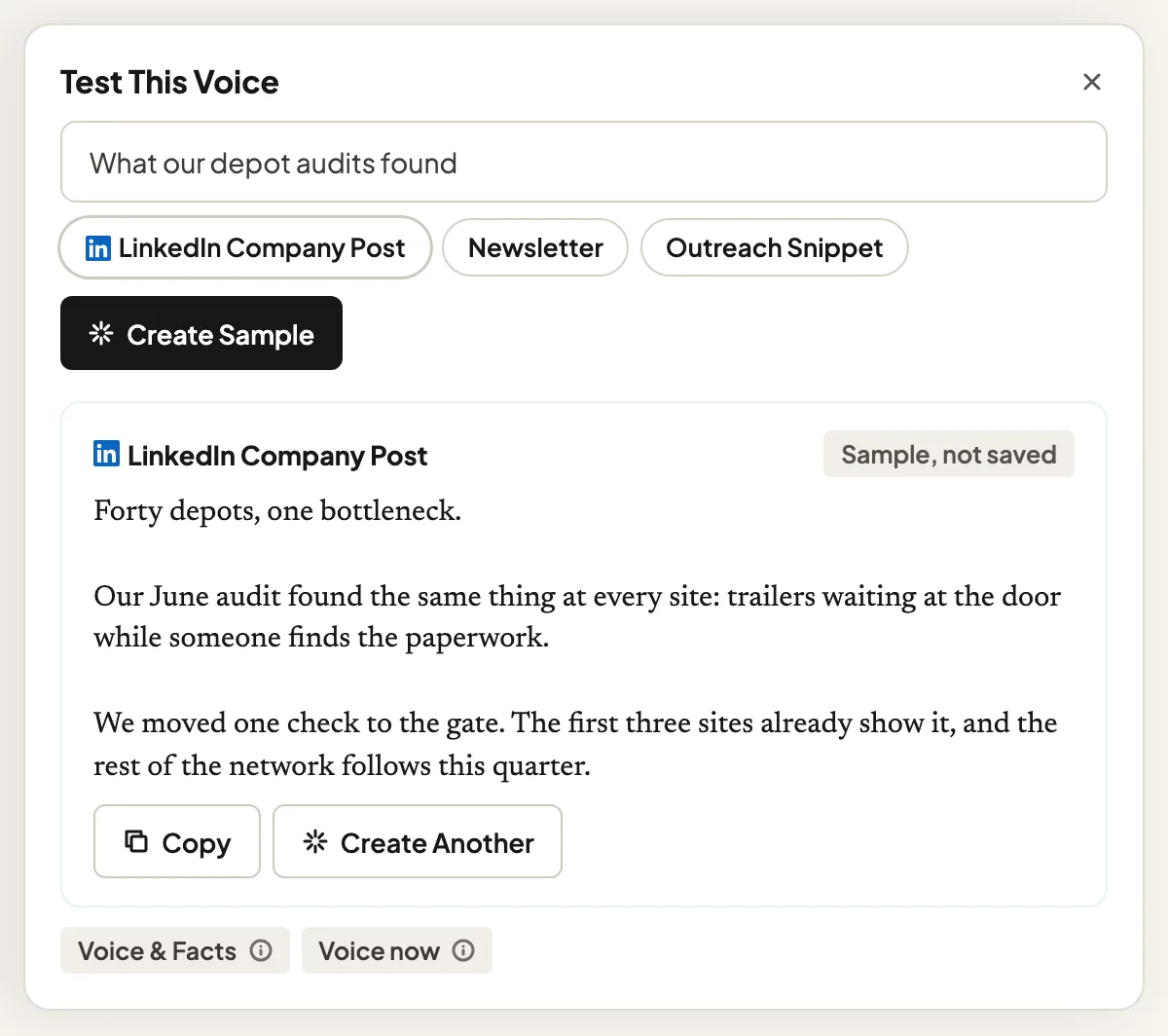
- Test it before the client sees it. Test This Voice writes a short sample on any topic, and nothing is saved.
Then the client approves on one link, with no login, and the approved version is what gets handed off. Want to see a prospect's voice before you sign them? Paste one of their pieces into our free voice reading.
Where it falls short: it can't give a draft a point the client never made. It creates from what you give it, and a blog post or article only from your client's own take. And a brand-new client with no writing of their own starts with only what you write down.
Questions People Ask
What is a brand voice example?+
A short description of how a brand sounds, written so a writer can act on it. Mailchimp's voice is plainspoken, genuine, and dry. Atlassian's is bold, optimistic, and practical, with a wink. Good examples also say what the brand isn't.
What are tone of voice examples?+
The same message written in different tones. "The filing deadline is April 15" is formal and matter-of-fact. "Tax day is two weeks out" is casual. Nielsen Norman Group sorts tone into four dimensions: formal or casual, serious or funny, respectful or irreverent, and matter-of-fact or enthusiastic.
What are 5 examples of tone words?+
Authoritative, caring, cheerful, conversational, and dry are five from Nielsen Norman Group's list of 37 tone words. Pick a few your client should sound like and a few they never should, like "sympathetic but not cheerful".
What's the difference between brand voice and tone?+
Voice is the personality that stays the same everywhere. Tone is how that personality adjusts to the moment and the reader. A client sounds like themselves in a launch post and an apology, but not the same in both.
What are the four types of tone of voice?+
Nielsen Norman Group's four dimensions are formal or casual, serious or funny, respectful or irreverent, and matter-of-fact or enthusiastic. Each is a spectrum, so a client's tone is a point on all four rather than one type.
How do you find your tone of voice?+
Collect a handful of pieces you wrote on good days, mark what they share, and place them on the four dimensions. Then write down when the tone should shift, for example warmer in an apology and plainer in a how-to.
How do you write a brand voice for a client?+
Start from five to ten pieces the client wrote or approved, mark their habits, and place them on the four dimensions. Then write the voice in two or three sentences with a "but not" for each trait, and add what they say, what they never say, and what they know to be true.
How do you check whether a draft matches a client's voice?+
Swap in a competitor's name. If the draft still works, it isn't the client's voice yet. Then read it beside two or three pieces the client wrote, and look for their words, their opinions, and the examples only they would use.
Written by the GoMimic team
GoMimic helps you create client content, get it approved, and deliver it, in each client’s voice.
Why It WorksMore from GoMimic
A Content Calendar Clients Can See and Approve
Client content calendar approval works when the plan and the words get separate answers. What to show, how to set dates, and what to do when a date moves.
ChatGPT for Client Work: Where It Strains Across a Roster
ChatGPT works well for client work with a project per client. At 20 clients it still leaves you the notes to keep current, the client's yes, and the hand-off.