Brand Voice Guidelines Template, With a Filled-In Example
- Published
- November 21, 2026
- Reading
- 8 min read
- Share
In This Piece
- The Short Version
- What Is a Brand Voice Guide?
- How Do You Create a Brand Voice Guide for Each Client?
- The Brand Voice Guidelines Template
- A Filled-In Example for a B2B Client
- How Does Tone Change by Channel?
- Which Rule Wins When Guides Disagree?
- How Do You Keep a Brand Voice Guide Current?
- Where GoMimic Fits
- Questions People Ask
A brand voice guidelines template should fit on one page per client: how they sound in their own sentences, words they use and avoid, what they'd never say, the facts a writer may use, and how the tone shifts by channel. If you write for several clients, add a short house style for your own team, and decide up front that the client's page wins when the two disagree.
The Short Version
- Just want the template? Copy the seven-part client page, then see it filled in.
- Writing for many clients? Keep two layers: a short house style, and one page per client.
- Two rules disagree? The rule closer to the client wins.
- Not sure what to fill in first? Start with what the client would never say. In our view it's the most useful line on the page.
- Want each client's page kept, checked on every piece, and getting better with every approval? That's what GoMimic does.

What Is a Brand Voice Guide?
A brand voice guide tells a writer how a brand sounds, in a form they can act on: real sentences, words to use and avoid, and the lines it won't cross. Tone is how that voice shifts by moment and channel. We cover the difference, with examples from brands that publish theirs, in brand voice and tone of voice examples.
The big published guides are written for one company. Mailchimp's content style guide runs from voice and tone to grammar, a word list, newsletters, and social media. That depth suits one brand. An agency writing for a dozen brands needs most of that once, as its own house style, and much less of it per client.
How Do You Create a Brand Voice Guide for Each Client?
Keep two layers, and write each one once.
- Your house style, for your own team: mechanics like the serial comma, numbers, dates, and headline capitals; the words nobody on your roster ever uses; how you handle facts (every figure from the client or a linked source); and one dictionary and one style manual to settle everything else.
- One page per client, in the same seven parts every time, so a writer can find the same thing in the same place for any client.
Then fill the client's page from their own writing, not from a meeting about adjectives. Our client onboarding questionnaire has the questions, and asks for that writing up front. "Friendly but professional" describes most companies. Three sentences from their best posts describe one.
The Brand Voice Guidelines Template
Copy these seven parts for each client. Keep the page to one screen.
- How they sound, in their own sentences. Three or four sentences copied from their best pieces, each with a line on why it sounds like them.
- Words they use, and words they avoid. Specific words, not adjectives.
- Things never to say. Phrases, claims, and comparisons the client has ruled out, in quotation marks.
- Facts you can use. Products, figures, proof points, and who their customers are, spelled their way.
- Tone by channel. What changes on LinkedIn, in the newsletter, in a long article, and in bad news.
- Who approves. The name, the backup, and how they like to be asked.
- Last updated. The date and what changed.
Start with part 3. At GoMimic we think what stays off limits, the things a client would never say and the beliefs they won't bend, does more for a draft than any description of their tone. A writer can guess at warm. They can't guess that the client never calls itself cheap.
A Filled-In Example for a B2B Client
Here's a made-up accounting firm's page, filled in. A B2B brand voice is still a person talking to a person, so it reads like one.
- How they sound: "Most owners don't need a bigger accountant. They need one who answers the phone." Short sentences, plain words, no jargon.
- Use: "owners", "your books", "on time". Avoid: "solutions", "leverage", "financial wellness".
- Never say: "guaranteed savings", "we'll handle the IRS", any comparison with a named competitor.
- Facts you can use: monthly bookkeeping and year-end tax filing; serves owner-run businesses in one state.
- Tone by channel: LinkedIn opens with a question an owner would ask. The newsletter ends with one action, never a pitch. Bad news (a missed deadline) is plain and early, with no jokes.
- Who approves: the managing partner, with the office manager as backup.
- Last updated: after the March call, when they asked us to stop saying "clients" and say "owners".

A writer who has never worked on the account can now draft a LinkedIn post without asking anyone which claims are allowed.
How Does Tone Change by Channel?
Voice stays put; tone moves with the channel and the moment. Write down the few shifts your client actually makes, rather than a chart of every possibility.
- Social posts: shorter, more direct, often a question first.
- Newsletter: warmer, one idea, one action.
- Long articles: the client's argument, made patiently, with their sources.
- Bad news or apologies: plain, early, and with no wit.
If you like a brand voice chart, keep it to these rows. Four dimensions of tone (formal or casual, serious or funny, respectful or irreverent, matter-of-fact or enthusiastic) come from Nielsen Norman Group's research and give you the columns (NN/g).
Which Rule Wins When Guides Disagree?
The one closer to the client. Google's developer documentation style guide sets a reference order that works just as well for an agency: project-specific style first, then the guide itself, then third-party references (Google).
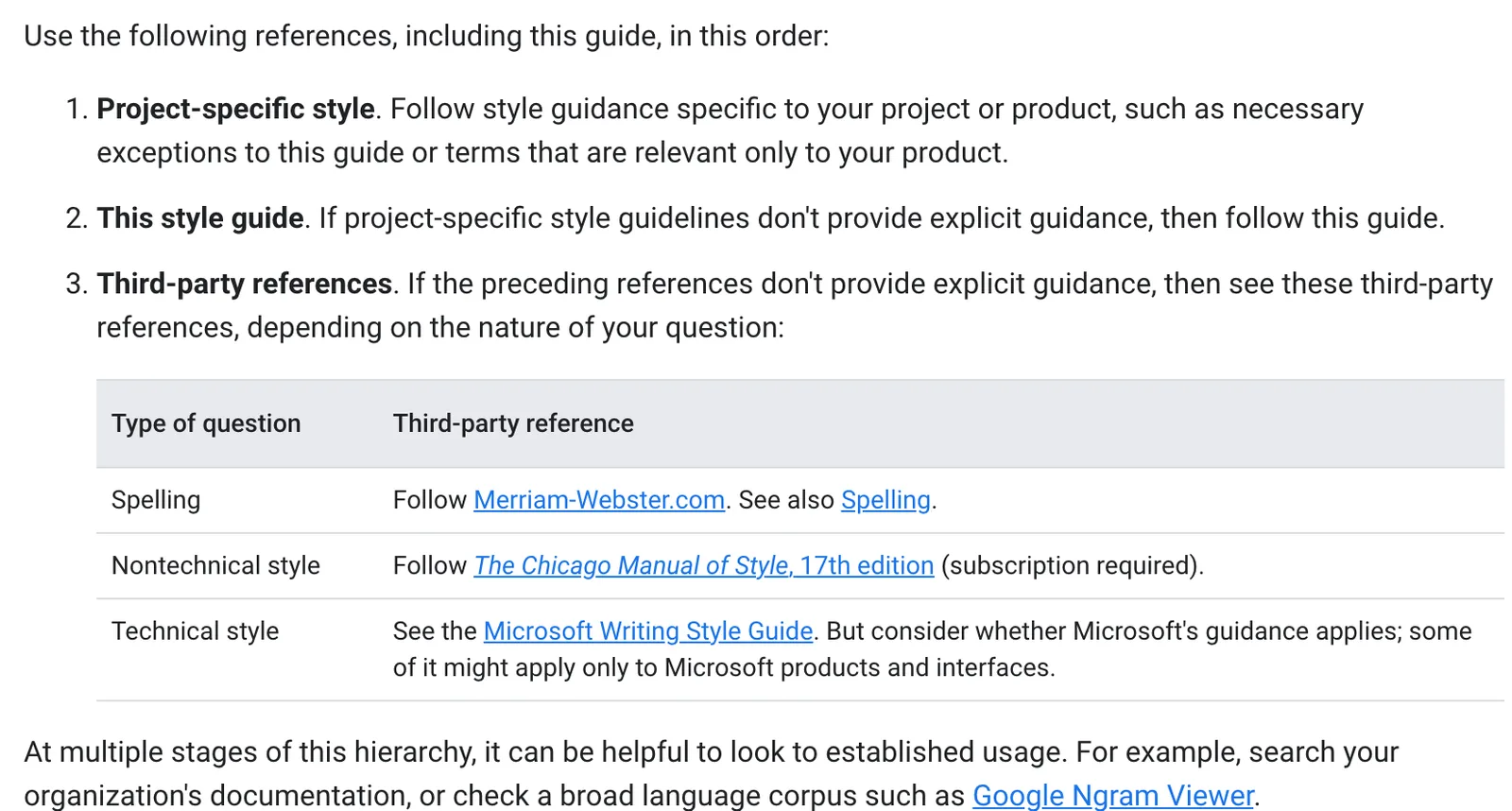
For an agency, that becomes:
- The client's page. Their words, their facts, their rules.
- Your house style. How your team writes when the client hasn't said otherwise.
- A general reference. One dictionary and one style manual, for everything else.
Write that order at the top of your house style, so nobody picks whichever rule they remember.
How Do You Keep a Brand Voice Guide Current?
A guide goes stale the week a client changes how they talk about themselves. Three habits keep it alive:
- Turn comments into rules. When a client writes "we never call ourselves cheap", add it to Never Say that day.
- Date every change, so a writer can see what changed since they last worked on the account.
- Ask the client to read their own page at each renewal. It's a short read for them, and it catches what nobody told you.
And remember what a voice guide is for. It's the floor, not the point. A draft can follow every line and still say nothing, so brief the client's idea first and let the guide carry it.
Off Limits First
The most useful line in any voice guide is what the client would never say.
Where GoMimic Fits
Create client content in each client's voice. Get it approved. Deliver it. GoMimic is the Connected Content System for Client Work, built for content worth putting your client's name on. We make it, so weigh what we say about it accordingly.
Each client in GoMimic has a page like the template above, and it's used on every piece, not filed away:
- Their rules, in your words. Their Rules hold How This Client Sounds, plain choices like sentence length and contractions, and lists to Use, Avoid, and Never Sounds Like.
- Never-say, checked every time. Things Never to Say checks every new piece for each quoted phrase, and Stock Phrases is your house list across every client.
- Bring your existing guide. Upload a client's style guide, or paste a GPT's instructions, and you get back suggestions to add or skip: facts, rules, and pieces that sound like them.
- Comments become rules. A client's note can be kept for next time with one press, and each client's voice gets better with every piece you create and every approval, so there's less to fix each time.
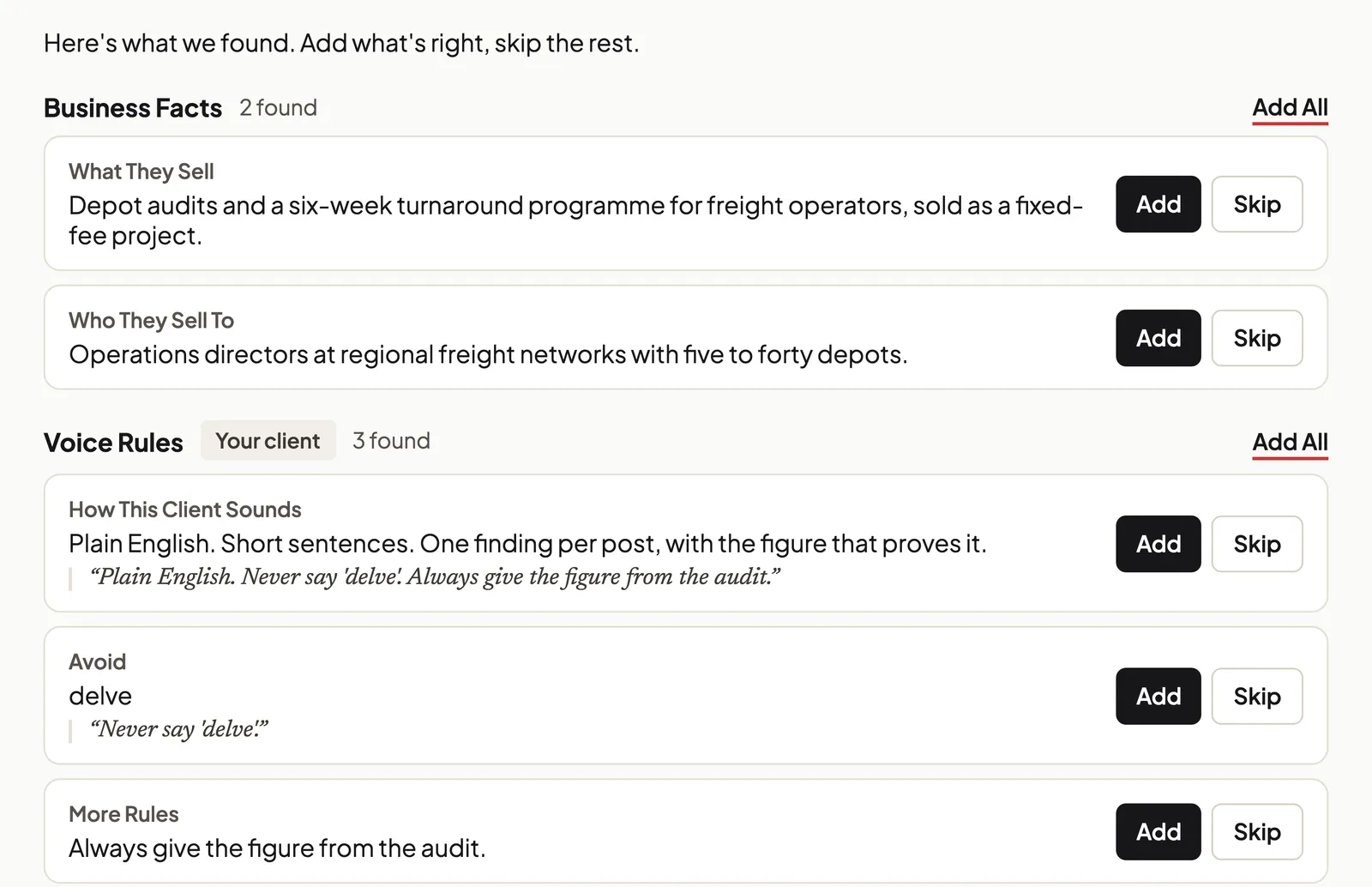
Where it falls short: it keeps each client's page and writes with it, but someone on your team still owns the rules. The never-say check matches the phrases you put in quotation marks, so it won't catch a claim you haven't written down. And it can't give a draft a point the client never made.
Questions People Ask
How do you create a brand voice guide?+
Start from the client's own writing. Copy three or four of their best sentences, list words they use and avoid, write down what they'd never say, add the facts a writer may use, and note how the tone shifts by channel. Keep it to one page.
Can you provide an example of a brand voice guideline?+
"Never say 'guaranteed savings'" is one. So is "LinkedIn opens with a question an owner would ask." Good guidelines are specific enough to act on; "be friendly" isn't.
What should a brand voice guidelines template include?+
Seven parts: how they sound in their own sentences, words to use and avoid, things never to say, facts you can use, tone by channel, who approves, and when it was last updated.
What is a brand voice chart?+
A table of a brand's voice traits against how each shows up, often with "we are this, not that" pairs. For client work, keep it to the few channels and moments you actually write for.
How long should a brand voice guide be?+
One page per client, plus a short house style for your own team. A page gets read. A long document per client gets opened once.
What is a B2B brand voice?+
The same idea as any brand voice, for a business that sells to businesses: specific, plain, and sounding like a person. Specific facts and the client's own opinions do most of the work, because a business reader is weighing whether to trust them.
Written by the GoMimic team
GoMimic helps you create client content, get it approved, and deliver it, in each client’s voice.
Why It WorksMore from GoMimic
Brand Voice AI: Keeping Each Client's Voice When AI Writes
What brand voice AI does, how to teach AI a client's voice, why it drifts across many clients, and how to keep each voice consistent and getting closer.
Brand Voice and Tone of Voice Examples, and How to Write Each Client's
Brand voice examples from brands that publish theirs, one message in four tones, and how to write each client's voice so every writer sounds like them.