Brand Voice AI: Keeping Each Client's Voice When AI Writes
- Published
- November 21, 2026
- Reading
- 8 min read
- Share
In This Piece
- The Short Version
- What Is Brand Voice AI?
- How Do You Teach AI a Client's Brand Voice?
- Why Does AI Lose a Client's Voice?
- Why Should a Human Thought Come First?
- How Do You Keep Brand Voice Consistent Across Many Clients?
- Is a Client's Voice Ever Finished?
- Do You Need a Tool That Writes the Voice Guide?
- Where GoMimic Fits
- Questions People Ask
Brand voice AI means giving an AI writing tool a brand's voice, its rules, examples, and words to avoid, so first drafts sound like that brand instead of like everyone. For an agency the hard part isn't one voice: it's keeping every client's voice separate, current, and getting closer with each approval, and that depends more on the client's own material and a person's review than on any setting.
The Short Version
- New to it? Here's what brand voice AI actually does, and what the main tools say they do.
- Setting up a client's voice? Teach it with their real writing, not a list of adjectives.
- Drafts drifting generic? Here's why AI loses a voice, and it's rarely the tool alone.
- Running many clients? Keep brand voice consistent per client, with one home for each voice.
- Want each client's voice to get better with every approval, and the client's yes on record? That's what GoMimic is for.

What Is Brand Voice AI?
It's any setup that makes an AI writing tool follow a brand's voice. Most tools do it the same way: you give them examples of the brand's writing and some rules, and they use those every time they write.
What the better-known tools say about it, on their own pages, checked November 20, 2026:
- Jasper describes brand voice management that scales "across brands, audiences, geographies, and languages", flags off-brand tone, and suggests changes (Jasper).
- Copy.ai has you paste original content, such as blogs, social posts, or emails, then analyze it into a brand voice you can review and tweak (Copy.ai).
- Chat tools like ChatGPT and Claude hold a voice in project instructions and files. We cover that setup in ChatGPT Projects for client work.
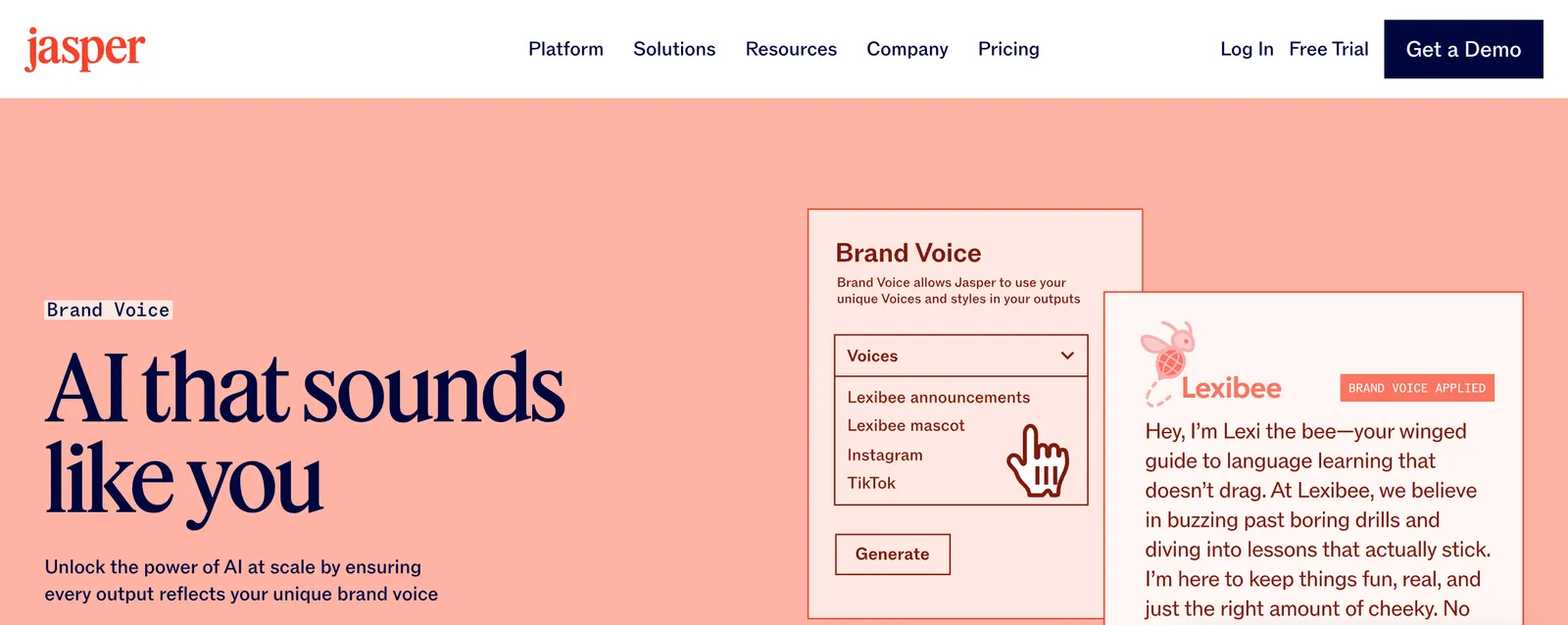
All of these can work. The question for an agency is what happens at fifteen or thirty clients: who keeps each voice current, and whether the voice gets better as the client approves work, or stays exactly as you first wrote it.
How Do You Teach AI a Client's Brand Voice?
With the client's own writing. Adjectives like "friendly but professional" describe half the market. Real pieces describe one client.
- Collect five to ten pieces the client wrote or approved with few changes, across the formats you create.
- Write down the words they never use, with the ones they've corrected you on first.
- Add their facts: what they sell, names and titles spelled their way, and claims they can and can't make.
- Add two or three sentences on how they sound, with a "but not" for each trait. "Warm, but never cutesy."
- Test it on a topic you've already delivered, and compare. If it's off, add better material before longer instructions.
Our brand voice and tone of voice examples show how to turn a tone into rules a writer, or a tool, can follow.
Why Does AI Lose a Client's Voice?
Usually because it had too little of the client to go on. Give AI a topic and a few adjectives, and it fills the gaps with the safest words it knows. That's how ten clients end up sounding like one.
The common causes:
- No real samples. A style description without the client's own writing.
- A voice set up once and never touched. The client repositions, and the notes still say last year's thing.
- Notes pasted in a hurry. The line about the word they hate falls off the end of the paste. We show how in where ChatGPT strains across a roster.
- Corrections that never go back in. The client fixes the same phrase in March and again in May.
Plenty of marketers feel it. In the Content Marketing Institute and MarketingProfs survey of 861 B2B marketers, 52% named maintaining brand voice and authenticity among their biggest challenges in using AI to create content (CMI, 2027 B2B trends research).
Why Should a Human Thought Come First?
Here's our point of view: a human thought leads, and AI follows it. A voice setting, however good, is a guardrail. It shapes how a draft sounds. It can't give the draft something to say.
Give AI the client's voice and no idea, and you get a draft that sounds right and says nothing. Give it the client's real point, their own material, and their take, and the voice has something to carry. That's the difference between a draft the client signs off and one they quietly rewrite.
Sounding right isn't the same as working. In an Ipsos test with Syracuse University's Newhouse School, only 13% of people who saw an AI-made ad were at least somewhat confident it was AI, the same share who suspected the human-made ads. Yet on Ipsos's sales-validated measures, the human-made ads came in 11 points above benchmark on average and the AI-made versions 5 points below (Syracuse University, May 18, 2026). Readers may not spot the AI. They still respond to the thinking behind the words.
So brief the thought first. The voice comes second, and the word lists come last.
How Do You Keep Brand Voice Consistent Across Many Clients?
Brand voice consistency is mostly a question of where each voice lives and who keeps it current. Brand voice management, at agency scale, comes down to a few habits:
- One home per client voice. Not a copy in each writer's tool. Four writers with four copies is four voices. We cover that in why each writer rebuilding client instructions breaks down.
- A second voice where the client has one. The founder and the company page rarely sound the same.
- Every correction goes back in the same day. A note from the client becomes a rule, not a memory.
- A person reads before the client does. Someone who knows the client checks the draft sounds like them, every time.
And read two clients' drafts with the names covered now and then. If you can't tell whose is whose, one of them has lost its voice.
Is a Client's Voice Ever Finished?
No, and that's fine. In our view, no voice will ever be 100% right, because clients change: a new product, a new market, a founder who starts saying things differently. What you can stop is hearing the same correction twice.
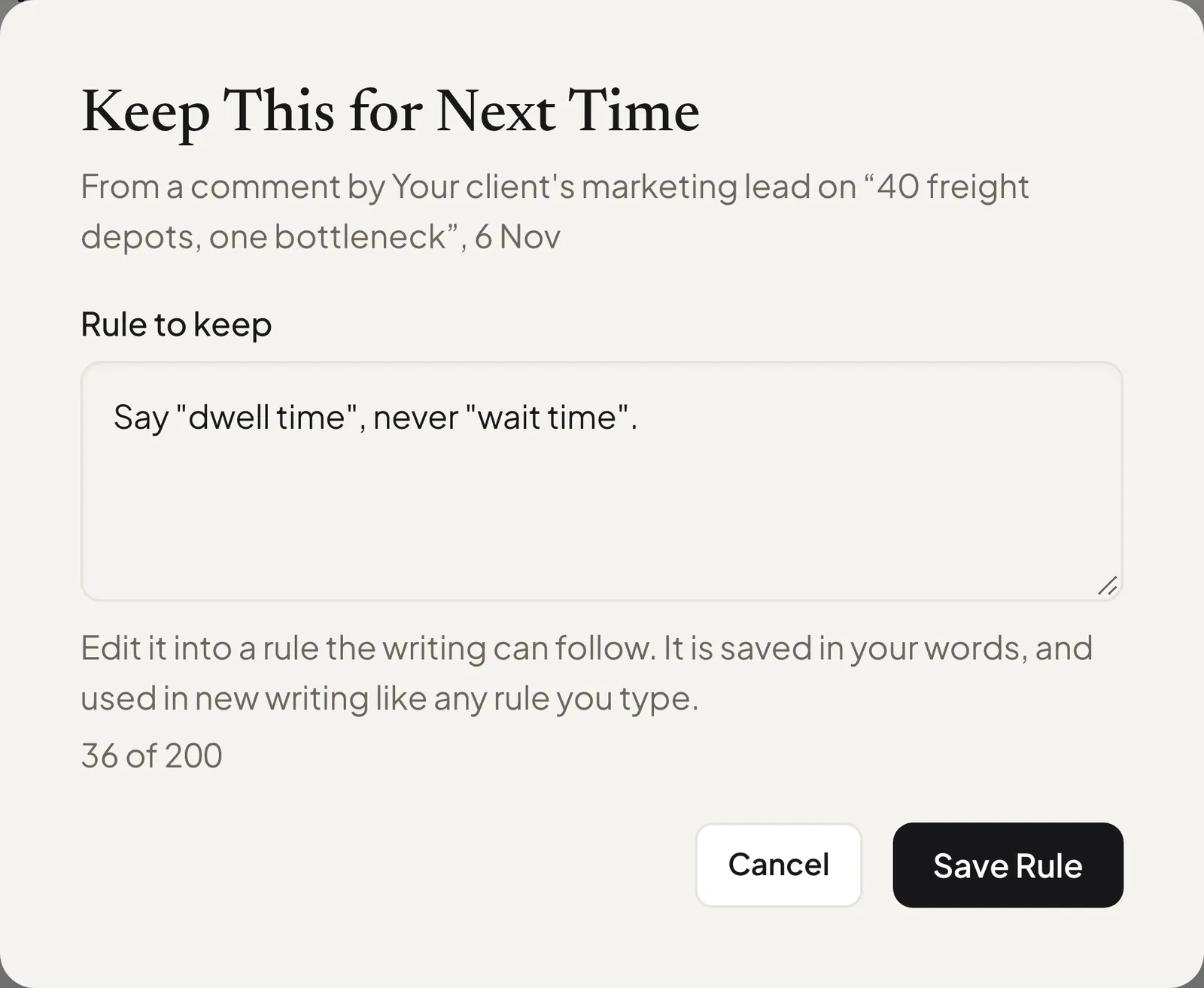
That's the loop that matters. The client approves some drafts and sends others back with notes. If those notes and approvals feed the next draft, each client's voice gets closer with every round. If they stay in an email, you'll be making the same fix next quarter.
Do You Need a Tool That Writes the Voice Guide?
Probably not as a starting point. Some tools turn a short description into a voice document: Storyflow's page, for one, describes turning a one-line brand description into personality, tone, and do and do-not examples (Storyflow). That's useful for a brand that has never written anything down. But a client you're writing for already has the best source there is: their own writing, and their reactions to your drafts. Start there.
Never the Same Note Twice
No voice is ever finished, because clients change. What you can stop is hearing the same correction twice.
Where GoMimic Fits
Create client content in each client's voice. Get it approved. Deliver it. GoMimic is the Connected Content System for Client Work, built for content worth putting your client's name on. We make it, so weigh what we say about it accordingly.
GoMimic isn't a voice setting. The voice is how it creates, for each client, and it gets better as you work:
- Their thought first. A blog post, article, or newsletter starts from Your Original Take: what your client thinks and what the piece is for.
- Learned from their writing. Add the client's writing and GoMimic learns their habits, each shown with the posts it came from. Habits from approved work are used only once your team keeps them.
- Better with every approval. Each client's voice gets better with every piece you create and every approval, so there's less to fix each time.
- The same note never twice. Keep This for Next Time turns a client's comment into a rule for their voice, and Things Never to Say is checked on every piece.
- A person before anything goes out. Your team signs off, then the client approves on one link, with no login, and the approved version is what gets handed off. GoMimic never posts.
Where it falls short: a brand-new client with no writing of their own starts with only what you write down, so the first drafts need more editing. It won't write an article from a keyword alone. And it can't tell you whether a draft has a point. That call stays with a person who knows the client.
Want to see a client's voice before you sign them? Paste one of their pieces into our free voice reading.
Questions People Ask
What is brand voice AI?+
An AI writing setup that follows a brand's voice, usually built from examples of the brand's writing plus rules like words to avoid. For an agency, it means one voice per client, kept apart and kept current.
How do you teach AI a brand voice?+
Give it five to ten real pieces the client wrote or approved, the words they never use, their facts, and two or three sentences on how they sound. Test it on a topic you've already delivered, and fix the material before the instructions.
Can AI keep a brand voice consistent?+
It can get close, when it has real material and one current home for each voice. A person who knows the client should still read every draft, and every correction should go back into the voice.
Why does AI content sound the same for every client?+
Usually because each draft had little of the client to go on. With no samples, facts, or take of their own, AI reaches for the safest words, and safe words sound like everyone.
What is a brand voice example?+
A short description of how a brand sounds that a writer can act on, like Mailchimp's plainspoken, genuine, and dry. We collect several, with tone examples, in brand voice and tone of voice examples.
Is AI brand voice better than a human writer?+
It's a different job. AI can hold a voice steady across many drafts. A person decides what the piece should say and whether it sounds like the client. In our view, the person leads and the AI follows.
Written by the GoMimic team
GoMimic helps you create client content, get it approved, and deliver it, in each client’s voice.
Why It WorksMore from GoMimic
Brand Voice and Tone of Voice Examples, and How to Write Each Client's
Brand voice examples from brands that publish theirs, one message in four tones, and how to write each client's voice so every writer sounds like them.
Brand Voice Guidelines Template, With a Filled-In Example
A brand voice guidelines template you can copy for every client: a short house style, one page per client, a filled-in B2B example, and which rule wins.